

Quick answer
Compound interest means interest is added to the balance so it earns interest itself: A = P × (1 + r/n)^(n × t). For example, 100 million at 7% a year compounded annually grows to 196,715,136 after 10 years, while simple interest gives only 170 million. Regular deposits speed this up a lot: 5 million a month for 20 years at 8% ends at about 2.95 billion.
What is compound interest?
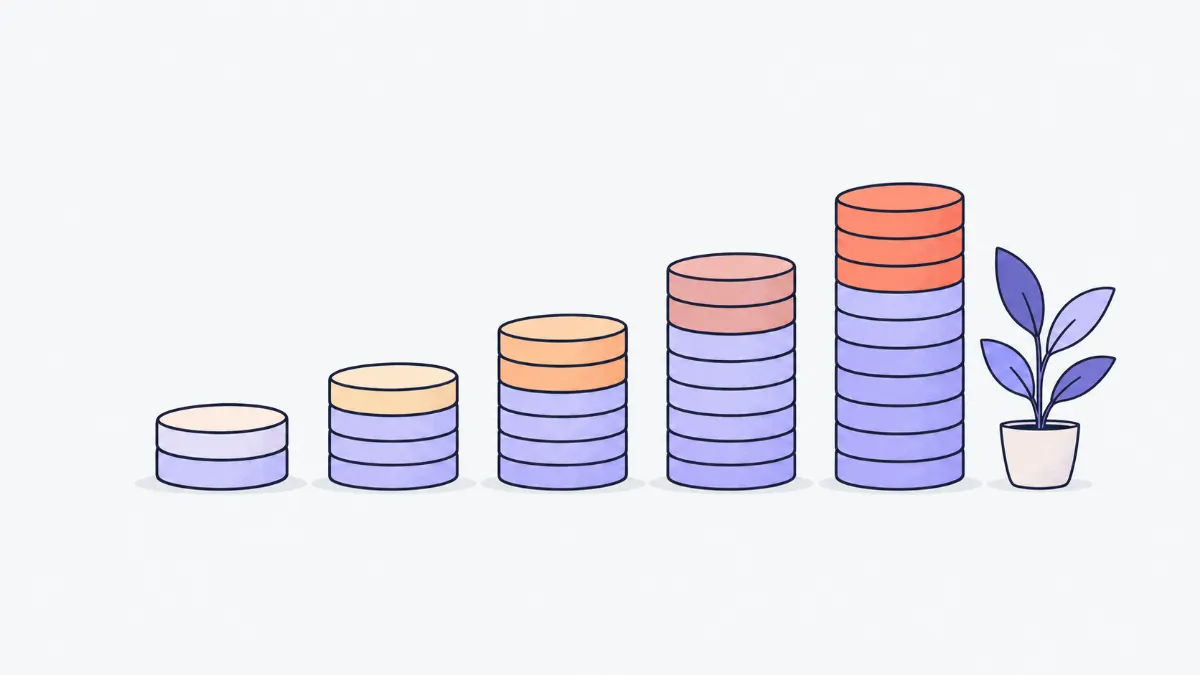
Compound interest is interest on interest: each period's interest joins the principal, so the next period earns on a bigger balance. This calculator simulates month by month with a starting amount, regular deposits (start or end of period), any compounding frequency and inflation, then charts contributions against interest year by year. Use it for savings goals, retirement pots or dollar-cost averaging with an expected return.
How to calculate compound interest
- 1
Enter the starting amount (100,000,000 or 100m both work). If you start from zero, leave it empty and enter only the contribution.
- 2
Choose how often you add money (monthly, quarterly, yearly), how much each time and whether it goes in at the start or end of the period.
- 3
Enter the interest rate or expected return per year, the number of years and the compounding frequency (term deposits usually compound at maturity; funds and savings accounts often daily or monthly).
- 4
To see real purchasing power, open “Inflation” and enter an expected rate (for example 3–4% a year).
- 5
Read the final balance, total contributed, interest earned, the chart and the yearly table; “Download CSV” opens it in Excel.
Same 100 million, 6% a year, 10 years: more frequent compounding earns more
| Compounding | Balance after 10 years | Effective annual rate |
|---|---|---|
| Simple interest | 160,000,000 | 6% |
| Yearly | 179,084,770 | 6% |
| Monthly | 181,939,673 | 6.168% |
| Daily | 182,202,895 | 6.183% |
Monthly versus daily makes little difference; the big gaps are simple versus compound interest and how many years you stay invested.
Rule of 72: how long until money doubles?
| Rate per year | Rule of 72 (estimate) | Exact (yearly compounding) |
|---|---|---|
| 6% | 12 years | 11.9 years |
| 8% | 9 years | 9.01 years |
| 10% | 7.2 years | 7.27 years |
| 12% | 6 years | 6.12 years |
Rule of 72: years to double ≈ 72 ÷ rate in percent. Exact: ln 2 ÷ ln(1 + r).
Worked examples
100 million at 7% for 10 years
Compounded yearly: 196,715,136, of which 96.7 million is interest. With 4% inflation it buys what 132.9 million buys today.
5 million a month at 8% for 20 years
No starting amount, end-of-month deposits, monthly compounding: 2,945,102,078 at the end, of which 1.2 billion is your own money and 1.745 billion is interest.
Double the time, not the effort
2 million a month at 10%: 409.7 million after 10 years, 1.52 billion after 20 years from only 480 million deposited. Most of the money appears in the second half.
Lump sum plus deposits
50 million to start, 3 million a month, 6% compounded monthly, 15 years: 995,160,815 (590 million deposited, 405 million interest).
Common mistakes
- Using a fund's best year as the rate for 20 years.
- Use a cautious long-term average and also try a lower scenario. Investments have losing years; the calculator assumes a constant rate.
- Ignoring inflation and thinking 3 billion in 20 years is a fortune.
- Enter 3–4% inflation to see the real value. At 4% a year, 1 billion in 20 years buys about what 456 million buys today.
- Comparing nominal rates with different compounding.
- Compare the effective annual rate (APY): 6% compounded monthly equals 6.168% a year.
- Choosing daily compounding for a fixed-term deposit.
- Term deposits usually add interest only at maturity when rolled over. For a 12-month deposit choose yearly; for a 6-month rollover choose every 6 months.
How the calculator works
It runs month by month: in a contribution month it adds the deposit (at the start if you choose start of period, at the end otherwise), then multiplies the balance by the monthly growth factor (1 + r/n)^(n/12). With monthly compounding this is the familiar formula and matches the annuity formula exactly; with other frequencies, mid-period deposits grow at the equivalent rate.
Real value = balance ÷ (1 + inflation)^years, the future amount in today's money. Taxes on interest, fund management fees and trading costs are not deducted.
Start or end of period?
Deposits at the start of each period earn one extra period of interest, so the result is always a little higher (the contributions are multiplied by 1 + the period rate). If you invest as soon as your salary arrives at the start of the month, pick start of period; otherwise pick end.
Glossary
- Compound interest
- Interest added to the principal each period, so later periods earn interest on earlier interest.
- Simple interest
- Interest on the original principal only: principal × rate × years.
- Compounding frequency
- How many times a year interest is added to the balance: yearly, half-yearly, quarterly, monthly, daily.
- APY (effective annual rate)
- The one-year rate including compounding: (1 + r/n)^n − 1.
- Rule of 72
- A quick estimate of the years needed to double money: 72 divided by the rate in percent.
- Dollar-cost averaging
- Investing a fixed amount on a schedule regardless of the market price at the time.
Frequently asked questions
What is the compound interest formula?
A = P × (1 + r/n)^(n × t), where P is the principal, r the annual rate as a decimal, n the compounding periods per year and t the years. With regular deposits an annuity term is added; the calculator does both.
Is a bank savings deposit compound interest?
Only if you roll over both principal and interest. If you take the interest out monthly, or roll over only the principal, it is simple interest. The Savings Interest Calculator models bank deposits more closely.
What return should I use for stocks?
There is no certain number. Run a few scenarios (for example 6%, 8%, 10% a year) and remember real returns swing and some years are negative.
How does inflation affect the result?
Inflation erodes the future value of money. “Real value” shows what the final balance is worth in today's money.
Are taxes included?
No. Results are before tax and fees. In Vietnam, interest on personal bank deposits is currently exempt from personal income tax, but other investment returns may be taxed.
Is what I enter stored?
No. Everything is calculated in your browser and nothing is sent to a server.
Ratings and comments
Loading…