

Quick answer
Enter a range (say 1 to 500), how many numbers you need, keep “No repeats” on and press “Draw”: numbers are picked with crypto.getRandomValues, so every number has the same chance. To pick people instead, paste a list of names into “Pick names”.
What is an online random picker?
One page for every kind of draw: raffle numbers, random winners from a list, splitting a class into even groups, or a quick coin flip or dice roll when you need a decision. Results come from the browser's cryptographic random source with bias removed, and a history log keeps the last draws so a public raffle can be checked afterwards.
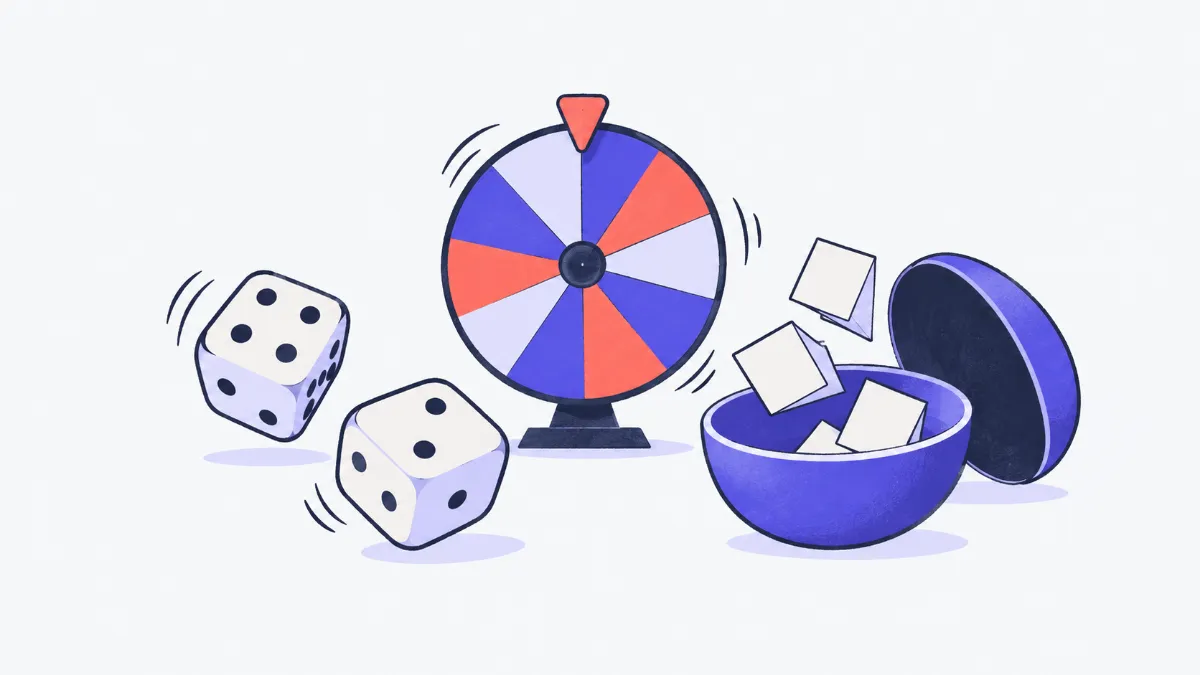
How to draw numbers and pick names
- 1
Choose a mode: “Numbers”, “Pick names”, “Split teams” or “Coin / dice”.
- 2
Numbers: enter “From”, “To” and “How many”; keep “No repeats” on when each number can win only once (raffles, prize draws).
- 3
Names and teams: paste the list, one name per line (a column copied from a spreadsheet works), then set how many winners or how many teams.
- 4
Press the button; the result appears after a short spin. Turn on “Remove winners from the list” to run several prize rounds without anyone winning twice.
- 5
Click “Copy result” to paste it into a chat; the “History” panel keeps the last 20 draws with the time of each.
Which mode should I use?
| Task | Mode | Suggested setting |
|---|---|---|
| Raffle with ticket numbers 1–300 | Numbers | From 1 to 300, How many = number of prizes, No repeats on |
| Pick 3 students out of a class of 40 | Pick names | Paste the class list, pick 3 |
| Split 24 people into 4 football teams | Split teams | 4 teams: 6 people each |
| Decide who pays for coffee | Coin / dice | Flip one coin, or everyone rolls one die |
| Two dice for a board game | Coin / dice | Roll 2 dice with 6 sides and read the total |
Odds of winning in a draw without repeats
With N numbers and k numbers drawn without repeats, each number wins with probability k ÷ N.
| Range | Prizes | Chance per number |
|---|---|---|
| 1–100 | 1 | 1% |
| 1–100 | 10 | 10% |
| 1–500 | 5 | 1% |
| 1–1,000 | 3 | 0.3% |
Real-world examples
Live-stream giveaway
Comments are numbered 1 to 850. Draw 5 numbers without repeats while sharing your screen so viewers see the spin and the history, then screenshot the result as a record.
Year-end party with several prize rounds
Paste the list of 120 staff and turn on “Remove winners from the list”. Third prize picks 10 people, second prize 5, first prize 1, and nobody wins twice.
Presentation groups
A class of 37 split into 6 groups gives five groups of 6 and one of 7, chosen at random so nobody argues about friends being grouped together.
Where to eat lunch
Type six restaurants, one per line, and pick one. End of discussion.
Common problems
- “Not enough numbers for a draw without repeats”.
- You asked for more numbers than the range contains (say 20 numbers from 1 to 10). Widen the range or allow repeats.
- Two people share a name.
- Each line counts as one person, duplicates included. Add something to tell them apart (Sam 10A, Sam 10B) so you know who won.
- Pasting from a spreadsheet merges columns.
- Copy only the name column; cells separated by tabs end up as one long name. Commas and semicolons are treated as separators.
- Wanting to repeat the exact same draw.
- That isn't possible by design: every draw is independent with no fixed seed. Keep the History panel or a screenshot as your record.
Is it really random?
Every result is drawn with crypto.getRandomValues, the browser's cryptographic random source. To keep every number equally likely, values that fall into the uneven remainder are discarded and redrawn (rejection sampling) rather than using a modulo, so no number is favoured.
Draws without repeats use a Fisher–Yates shuffle, the digital version of pulling tickets from a hat without putting them back. The spin animation is just for show: the result is already decided before it plays and does not depend on when you click.
Everything runs in your browser. Your list of names is never sent anywhere, and the website cannot know or influence the outcome.
Glossary
- Without replacement
- A number that has been drawn cannot come up again, like pulling tickets out of a hat.
- With replacement
- Each draw is independent and a number can appear more than once, like rolling a die repeatedly.
- Fisher–Yates shuffle
- An algorithm that shuffles a list so that every order is equally likely.
- crypto.getRandomValues
- A browser function that produces random numbers suitable for cryptography, far less predictable than Math.random.
Frequently asked questions
Can I use negative or very large numbers?
Yes: whole numbers from negative values up to about 9 quadrillion, with a range of up to about 4.29 billion numbers and up to 1,000 numbers per draw.
Is my list of names saved?
No. It only lives on the page; reload and it's gone. The history is kept only while the page is open.
How do I show viewers the draw is fair?
Share your screen while drawing so everyone sees the list and settings before you click; the History panel timestamps each draw for checking later.
Are teams balanced?
Yes. The list is shuffled and dealt out in turn, so teams differ by at most one person.
Is the coin flip really 50/50?
Yes, each flip is a random 0 or 1 with equal probability. Flip several at once and the tool also counts heads and tails.
Does it work on a phone during a live stream?
Yes. The layout fits a phone screen, the button is large and the results are shown in big type.
Ratings and comments
Loading…