

Contents
Vietnam's Lunar New Year 2027 is the Year of the Goat, called Đinh Mùi in Vietnamese, and the first day of Tết falls on Saturday 6 February 2027. The last month of the outgoing Year of the Horse has only 29 days, so there is no "30th of Tết" this time: New Year's Eve is the night of Friday 5 February into Saturday 6 February.
Key takeaways
- 2027 is the Year of the Goat (Đinh Mùi); the lunar year runs from 6 February 2027 to 25 January 2028.
- First day of Tết: Saturday 6 February; second day: Sunday 7 February; third day: Monday 8 February 2027.
- Kitchen Gods' Day is Saturday 30 January; the first full moon of the year is Saturday 20 February 2027.
- Vietnam and China celebrate on the same day in 2027, even though Vietnam's calendar runs on UTC+7.
- The Vietnamese zodiac has a Cat instead of a Rabbit; the eighth animal, Mùi, is usually drawn as a goat.
- Civil servants are off from 4 to 10 February 2027; private companies set their own five-day schedule.
Which animal is 2027?
The Vietnamese calendar names each year by pairing one of ten heavenly stems with one of twelve earthly branches, giving a 60-year cycle. For 2027 the stem is Đinh and the branch is Mùi, the eighth animal of the zodiac. In Vietnam Mùi is pictured as a goat (con dê); you may also see "sheep" or "ram" in English, which refer to the same sign.
Two details surprise many newcomers:
- The Cat replaces the Rabbit. Someone born in a Year of the Rabbit elsewhere is a "Cat" in Vietnam (tuổi Mão).
- The year starts at Tết, not on 1 January. A baby born on 20 January 2027 is still a Horse (Bính Ngọ); one born on 10 February 2027 is a Goat.
The Vietnamese zodiac and element finder turns any date of birth into the lunar year, animal and element, which is handy for colleagues born in January or early February.
Key dates for Tết 2027
| Occasion | Lunar date | Solar date | Weekday |
|---|---|---|---|
| Full moon of the 12th month | 15/12 Bính Ngọ | 22 Jan 2027 | Friday |
| Kitchen Gods' Day (Ông Công Ông Táo) | 23/12 Bính Ngọ | 30 Jan 2027 | Saturday |
| Start of spring (Lập xuân) | 28/12 Bính Ngọ | 4 Feb 2027 | Thursday |
| Year-end dinner and New Year's Eve | 29/12 Bính Ngọ | 5 Feb 2027 | Friday |
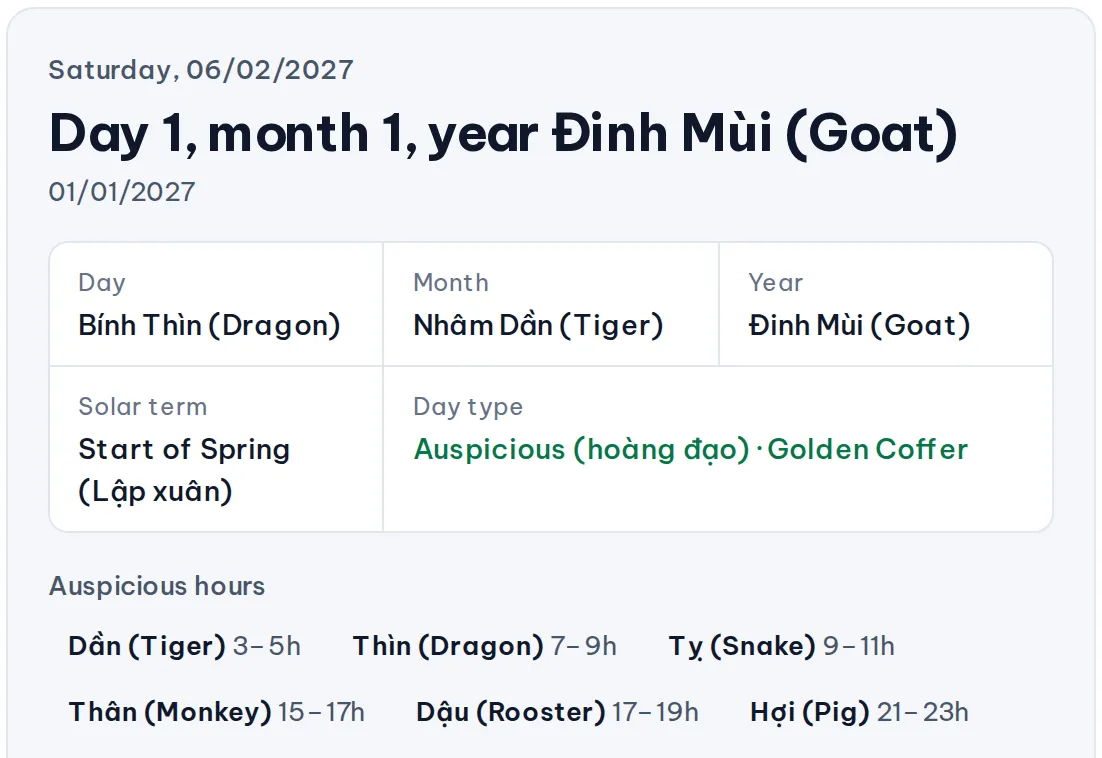
| First day of Tết | 1/1 Đinh Mùi | 6 Feb 2027 | Saturday |
| Second day of Tết | 2/1 Đinh Mùi | 7 Feb 2027 | Sunday |
| Third day of Tết | 3/1 Đinh Mùi | 8 Feb 2027 | Monday |
| God of Wealth Day (vía Thần Tài) | 10/1 Đinh Mùi | 15 Feb 2027 | Monday |
| First full moon (Rằm tháng Giêng) | 15/1 Đinh Mùi | 20 Feb 2027 | Saturday |
Dates and weekdays come from the Vietnamese lunar calendar converter in Vietnam time.
For the official days off, including the seven-day break for civil servants and the options private employers can choose, see Tết 2027 and Vietnam's public holidays.
What happens on each day
Kitchen Gods' Day: Saturday 30 January
On the 23rd day of the last lunar month, families send the Kitchen Gods back to heaven to report on the household's year. You will see people releasing live carp into lakes and rivers, the fish being the gods' ride. For many households this is when the serious cleaning and shopping start.
New Year's Eve: Friday 5 February
The year-end meal (tất niên) and the offerings to ancestors happen on the last day of the old year. At midnight comes giao thừa, the moment the old year hands over to the new one. Expect fireworks displays in big cities and very quiet streets right afterwards. If you want to count down with friends, set the moment in the countdown and stopwatch tool.
The first three days: 6–8 February
A common saying assigns the first day to the father's side of the family, the second to the mother's side and the third to teachers. In practice:
- Day 1 (Saturday): the first visitor to a home (xông đất, "first-footing") is believed to set the tone for the year, so families often invite someone in advance. If you are not asked, it is polite to visit from the second day on.
- Day 2 (Sunday): visits to relatives and close friends.
- Day 3 (Monday): visits to teachers; many families burn votive paper to see the ancestors off on the third or fourth day.
After Tết
Shops reopen gradually from about the fourth to the sixth day. On the 10th day (Monday 15 February) many business owners buy a little gold for luck. The first full moon, Saturday 20 February, is one of the busiest days at pagodas all year.
Customs worth knowing if you live in Vietnam
- Lucky money (lì xì). Small amounts in red envelopes go to children and elderly relatives. New, crisp notes are preferred; the amount matters less than the gesture.
- Greetings. "Chúc mừng năm mới" means "Happy New Year". Wishing good health (sức khoẻ) and prosperity is always welcome.
- Gifts. Fruit, tea, sweets, wine or a gift basket are typical when visiting a Vietnamese home during Tết. Avoid giving sharp objects as gifts.
- Superstitions. Some families avoid sweeping the floor or lending money on the first day, believing it sweeps or gives away luck. These are folk beliefs and practices vary widely by family and region.
- Closures. Markets, small restaurants and many services close for several days. Stock up beforehand, withdraw some cash and expect higher prices for taxis and delivery just before and during Tết.
The Year of the Goat in folk belief
In the five-element system used in Vietnamese almanacs, Đinh Mùi belongs to Water of the Milky Way (Thiên Hà Thủy), the same element as 2026. The Goat is traditionally associated with gentleness and creativity. Treat this as folk tradition, not science: people consult it for fun or out of respect for family customs, for example when choosing a day to open a shop.
Frequently asked questions
What date is Lunar New Year 2027 in Vietnam?
Saturday 6 February 2027. New Year's Eve is the night of Friday 5 February.
Is 2027 the Year of the Goat or the Sheep?
It is the same sign, Mùi. In Vietnam it is drawn and described as a goat (con dê), so "Year of the Goat" is the usual English name here.
Is Vietnamese Tết on the same day as Chinese New Year in 2027?
Yes. Both fall on 6 February 2027. In some years they differ by a day because Vietnam's lunar calendar is calculated in UTC+7 and China's in UTC+8.
When does the Year of the Goat end?
On 25 January 2028. The next lunar year, Mậu Thân (Year of the Monkey), starts on 26 January 2028.
How long are the Tết holidays in 2027?
Civil servants are off for seven days, from 4 to 10 February 2027. Private companies give five Tết days, plus a day in lieu where a holiday falls on their weekly rest day; check with HR.
Free tools used in this article
- Vietnamese Lunar Calendar →Convert between solar and Vietnamese lunar dates, with stem-branch names, solar terms and lucky hours.
- Vietnamese Zodiac & Element →Find the lunar year, zodiac animal and nạp âm element of a birth date, plus Vietnamese age.
- Countdown & Stopwatch →Countdown timer with alarm, lap stopwatch and days-until-event counter.
#lunar new year 2027#year of the goat#tet 2027#vietnamese zodiac